


 Key takeaways
- Best overall: ESET. 20%+, 45-day cookie, and it pays on renewals. In a subscription category, that compounds.
- Best for high AOV: Bitdefender. 20% consumer, 50% business, custom deals higher. The business licenses are where the money is.
- Best flat payout: TotalAV. Around $70 per sale, fixed. Biggest first transaction on this list.
- Best for Mac: Intego. 15% to 50%, 45-day cookie, and far less competition than "best antivirus."
- Best for beginners: Malwarebytes. Up to 40%, 45-day cookie, straightforward approval, and a brand your readers already trust.
- Skip for US traffic: Kaspersky. Solid terms, but it hasn't been able to legally sell to Americans since 2024.
Most antivirus affiliate roundups rank programs by headline commission rate. It's the wrong number.
A 40% commission on a $45 product pays less than a 20% commission on a $150 one. A program that commissions renewals is worth two or three times a program that doesn't, on identical traffic. And a program with a beautiful rate that can't legally sell to your audience pays you exactly nothing.
So we did this differently. Over about two weeks in July and August 2026 we pulled the official affiliate page for every antivirus brand we could find running a live program, cross-checked each one against its network listing (CJ, Impact, FlexOffers, Partnerize), and recorded what the brand actually publishes rather than what the roundups repeat. Fourteen programs made the cut. Where a term was hidden behind an application gate or two sources disagreed, we say so instead of guessing.
Three things you should know before you scroll:
Antivirus is a renewal business, so whether a program pays on renewals matters more than its headline rate. Antivirus also runs 30-day money-back guarantees as standard, which means a slice of your commissions reverse every month. And four of the biggest "different" brands on this list are owned by the same company.
Here's what we found.
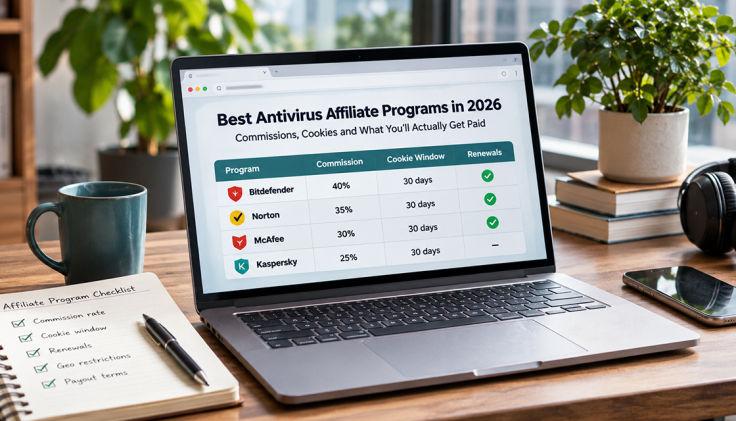
Antivirus affiliate program comparison
All terms below reflect what each brand or network published as of August 2026. Cells marked on approval mean the term is only disclosed after your application is accepted. Cells marked unverified mean we found conflicting figures and won't pick one for you.
| Program | Network | Headline commission | Cookie | Renewals commissioned? | Best for |
|---|---|---|---|---|---|
| ESET | CJ | 20%+ (up to 30% on the UK program) | 45 days | Yes | Consumer AV review sites |
| Bitdefender | Impact | 20% new customers, 50% business, custom deals higher | On approval | Renewal rates vary by region | High-AOV and B2B content |
| Malwarebytes | CJ | Up to 40% | 45 days | No | Malware-removal content |
| Intego | CJ or Impact | 15%–50% | 45 days | Yes (renewals and upsells) | Mac and iOS publishers |
| TotalAV | CJ / FlexOffers | ~$70 flat CPA | 45 days | No | US/UK/AU/CA review traffic |
| AVG (Gen Digital) | CJ | Up to 35% | 60 days | No | Budget and free-tier comparisons |
| Avast (Gen Digital) | CJ | 25%–30% | Unverified | No | Windows and Mac consumer content |
| Norton (Gen Digital) | CJ, Impact, regional | ~20%–25% baseline, varies widely by network | Unverified (30–60 days reported) | No | Brand-name conversion volume |
| Avira (Gen Digital) | CJ / TradeTracker | 25% | 45 days | No | European consumer traffic |
| McAfee | FlexOffers (NA), Partnerize, regional | 32% NA, 18% work-from-home program, $10 flat APAC | 45 days NA, 90 days Partnerize | No | US publishers wanting brand trust |
| Trend Micro | Impact | Up to 20% | 30 days | No | APAC and Europe tech content |
| Panda Security (WatchGuard) | Direct application | Up to 35% | 30 days | No | Spanish-language and EU traffic |
| Surfshark One | Impact, TUNE, Avantlink, others | 40%+ on new and recurring sales | 30 days | Yes | Privacy and VPN crossover audiences |
| Kaspersky | In-house | 20% base, up to 50%+ | 30 days (some longer) | On approval | Non-US traffic only |
How we verified these
Every figure above came from one of three places: the brand's own affiliate landing page, its live network listing, or its published affiliate terms. When a directory site disagreed with the brand, we took the brand.
We deliberately did not include programs we couldn't confirm were still accepting applications, programs promising commissions above 60% without a named merchant behind them, or "antivirus deal aggregator" programs that resell other brands' licenses. The Huntress security team makes a fair point that rates above 50-60% in this category are a common signature of fraudulent programs, and we'd rather list fourteen real ones than twenty-five padded ones.
Terms change without notice. Treat this page as a shortlist, then confirm on the network before you write a word of content.
The four numbers that decide what you actually earn
This is the part most guides skip, and it's the part that determines whether your antivirus content makes $40 a month or $4,000.
1. Dollars per sale, not percent per sale
Run the math on your actual products, not the headline.
Malwarebytes Premium sits around $44.99 a year. At 40%, that's roughly $18. ESET at 20% on a $60 license is $12, which looks worse until you add the renewal. Bitdefender's 20% on a $90 Total Security subscription is $18. TotalAV's flat $70 beats all three on the first transaction and pays nothing after.
Meanwhile Bitdefender's 50% on business products, where a small-business license can run several hundred dollars, is a different order of magnitude entirely. Same program, completely different economics depending on which product page you send traffic to.
Do this exercise before you apply, not after. If you're new to comparing payout structures, our breakdown of the five types of affiliate commission is a useful primer.
2. Whether renewals are commissioned
Antivirus is one of the stickiest consumer subscriptions there is. People renew out of inertia for years.
Three programs on this list pay you for that inertia. ESET states plainly that affiliates earn recurring revenue on new purchases and renewals. Intego advertises recurring revenue opportunities from renewals and upsells. Surfshark pays 40%+ on new and recurring sales alike.
Everyone else pays once and keeps the annuity.
The difference compounds fast. A referred customer who stays four years is worth roughly four times as much on ESET as on an identical one-time program. If you're building evergreen content that will still rank in three years, this should probably be your primary filter. We've written more on why recurring commission structures change the shape of a content business.
3. Your approval rate after refunds
Here's the one nobody puts in a comparison table.
Bitdefender and Panda both run 30-day money-back guarantees. Most of this category does. Every one of those refunds reverses your commission, and antivirus attracts a particular kind of buyer: someone panicked about a suspected infection, who buys fast and sometimes regrets it just as fast.
One network listing we reviewed for Bitdefender carried a blunt note in its campaign rules that the decline rate is very high. That's the merchant telling you, in advance, that your reported earnings and your paid earnings will not match.
Plan for it. Track gross versus approved commission separately from month one, and judge programs on approved. Refunds quietly kill more affiliate income than low commission rates do, and antivirus is one of the worst categories for it.
4. Whether the program can legally sell to your audience
Two live examples, both routinely missed.
Kaspersky cannot sell to US customers. The US Department of Commerce's Bureau of Industry and Security issued a Final Determination in June 2024 prohibiting Kaspersky Lab and its affiliates from providing antivirus software to US persons. New sales stopped July 20, 2024, and signature and codebase updates stopped September 29, 2024. The program itself is fine and the terms are competitive, but if your traffic is predominantly American, this is a dead link on your page. Every competing guide we audited still lists Kaspersky without the caveat.
ESET's US program serves a limited region. ESET states that eset.com accepts orders from customers located in the US, Canada and the Caribbean only. Excellent program, but if a third of your readers are in India or Brazil, a third of your clicks cannot convert. The UK program covers different territory at a different rate.
Check the merchant's shipping-and-service region against your Analytics geo report before you commit. It takes four minutes and saves you a quarter's work.
The one nobody tells you: four of these are the same company
Norton, Avast, AVG and Avira are all owned by Gen Digital, which also owns LifeLock and CCleaner. Gen Digital reported fourth-quarter revenue of $1.01 billion and guided to $4.70–$4.80 billion for full-year 2026, so this is not a small conglomerate.
Which means the affiliate who carefully "diversifies" across Norton, Avast, AVG and Avira has diversified across precisely nothing. One commission-policy change at Gen Digital hits all four rows of your spreadsheet in the same week.
If you want genuine diversification in this niche, pair one Gen Digital brand with an independent (ESET, Bitdefender, Malwarebytes) and one specialist (Intego for Mac, Surfshark for privacy crossover). Three merchants, three companies, three sets of terms.
The 14 programs in detail
1. ESET Online Affiliates

Why affiliates choose it: The renewal commissioning is genuinely rare in this category and it changes the lifetime value of every referral you send. ESET also runs seasonal discount codes and long-term offers, which gives you something to write about besides "here's a product."
Limitations: The geographic restriction on the US store is a real constraint, and 20% is mid-table on headline rate. You're trading upfront percentage for durability.
Best for: Review sites and YouTube channels covering consumer antivirus with North American audiences, especially anyone building content designed to rank for years.
2. Bitdefender
Why affiliates choose it: The product range is the widest here, so one merchant covers antivirus, VPN, password management and identity protection. The 50% business rate on high-AOV licenses is the most under-exploited opportunity on this page. A dedicated affiliate manager comes with the account.
Limitations: The published cookie window is vague, and that high decline rate is a warning worth taking seriously. Your reported earnings will overstate your paid earnings.
Best for: Publishers with small-business or IT-buyer audiences, and anyone who wants one merchant relationship covering several product categories.
3. Malwarebytes
Why affiliates choose it: Brand affection. Malwarebytes is the tool a huge number of people were told to download by a friend when their computer got weird, which means it converts on trust rather than persuasion. Up to 40% is at the top of this table, and Malwarebytes handles all billing and support so you inherit none of the customer-service load.
Limitations: Low AOV caps your per-sale dollars, and no renewal commission means every year starts from zero.
Best for: Malware-removal tutorials, "how to tell if you have a virus" content, and beginners who want a program with a short approval cycle and a product they've likely used themselves.
4. Intego

Why affiliates choose it: Mac security is a far less contested search space than general antivirus, and Intego has been Mac-only since the late 1990s, which gives your content a credible specialist angle. The renewal component plus the 50% ceiling makes this the highest-potential program here for a well-matched audience.
Limitations: Your total addressable market is Mac and iOS users, so the ceiling on volume is lower. The 15% floor is unattractive until your volume climbs.
Best for: Apple-focused blogs and channels, "is Mac antivirus necessary" content, and anyone already ranking for macOS troubleshooting queries.
5. TotalAV
Why affiliates choose it: The flat payout is the highest single-transaction figure in this comparison, and the desktop flow is a free download rather than a straight purchase, which lifts conversion rate meaningfully.
Limitations: Read the compliance policy properly before you spend a day on creative. Several standard affiliate tactics are explicitly off the table, and the validation period means a month's lag before commissions confirm.
Best for: Review and comparison sites with tier-one English-language traffic who want the biggest first-transaction payout available.
6. AVG (Gen Digital)
Why affiliates choose it: The 60-day cookie is a genuine edge in a category where people research antivirus for weeks before buying. Up to 35% is respectable, and AVG's free tier gives you a natural content hook for upgrade comparisons.
Limitations: Gen Digital ownership, so this doesn't diversify you away from Norton or Avast. Check and wire only is a friction point for affiliates outside the US.
Best for: Free-versus-paid comparison content and budget-conscious consumer audiences.
7. Avast (Gen Digital)

Why affiliates choose it: Avast is the second-largest consumer antivirus brand by install base and covers Windows, Mac, Linux and server, so there's a product for almost any reader. The freemium funnel means readers often already have it installed.
Limitations: Gen Digital ownership again. And Avast's history with user-data controversy is something a thorough reviewer will need to address honestly rather than skip.
Best for: General consumer tech content and multi-OS comparison pages.
8. Norton (Gen Digital)
Why affiliates choose it: Brand recognition converts. A reader comparing Norton to a name they've never heard of picks Norton most of the time, and that trust is already priced into your conversion rate before you write a sentence.
Limitations: The fragmentation is the story here. The same brand pays wildly different rates depending which network you sign up through, which means the network you pick matters as much as the merchant. Apply through two and compare EPC before you commit your best placements. That legacy-product blacklist is also easy to fall foul of if you link to older SKUs.
Best for: High-volume publishers who can test multiple networks and pick the winner on data.
9. Avira (Gen Digital)
Why affiliates choose it: Avira Prime covers up to 25 devices and the brand runs frequent discounts of up to 50%, which gives you genuinely promotable offers. Strong European recognition, particularly in German-speaking markets.
Limitations: Gen Digital, again. And 25% with no renewal commissioning is mid-table on both axes.
Best for: European traffic and multi-device family security content.
10. McAfee

Why affiliates choose it: 32% on the NA program is one of the better percentage rates here attached to a genuinely household name. McAfee ships preinstalled on a lot of laptops, so a meaningful share of your readers are already trial users looking for a renewal decision.
Limitations: NET 60 means you wait two months after month-end to get paid. And like Norton, the multi-network structure means an affiliate can accidentally join the 18% program when the 32% one was available.
Best for: US publishers wanting maximum brand trust, and anyone writing renewal-decision content for preinstalled trials.
11. Trend Micro
Why affiliates choose it: Trend Micro is a genuine market leader in hybrid cloud and endpoint security with strong AV-TEST scores, and it's under-promoted by Western affiliates relative to its size. Less competition for the branded search terms.
Limitations: 20% and a 30-day window are both at the low end of this table. Trend Micro also applies last-click attribution in the usual way, so an intervening affiliate link overwrites your cookie.
Best for: Publishers with Asia-Pacific or European audiences, and business-security content.
12. Panda Security (a WatchGuard company)
Why affiliates choose it: Up to 35% is competitive, and Panda's Spanish-language market position is strong in a space where most affiliate competition is English-only. Panda Dome includes VPN and parental controls, which broadens your content angles.
Limitations: 30-day cookie, no renewal commissioning, and a 30-day money-back guarantee that will reverse a share of your sales.
Best for: Spanish-language and southern European publishers, and family-safety content.
13. Surfshark One

Why affiliates choose it: The recurring component on a 40% base is the strongest combination on this page for a well-matched audience. No website requirement makes it accessible for creators working primarily on YouTube or newsletters.
Limitations: Antivirus is bundled rather than standalone, so this is really a privacy-suite program with AV attached. If your readers specifically want a dedicated antivirus, the fit is weaker. The $100 threshold is the highest here.
Best for: Privacy, VPN and general online-security audiences, and creators without a traditional blog.
14. Kaspersky

Why affiliates choose it: For non-US traffic the terms are among the best here, and the affiliate team is unusually accessible for a company this size. Kaspersky's detection scores remain excellent.
Limitations: If your audience is American, this program is unusable regardless of how good the rate is. Even for non-US traffic, a fair review has to address the trust question, which some publishers would rather not take on.
Best for: Publishers with predominantly non-US audiences who are comfortable covering the geopolitical context honestly.
How to match a program to your audience
The mistake is picking on rate and hoping your readers cooperate. Work the other direction.
If your traffic is mostly Mac users, start with Intego. Nothing else on this list is built for them, and specialist relevance beats a two-point commission difference every time.
If you write malware-removal tutorials, Malwarebytes converts because it's the tool people already associate with cleanup. Someone landing on "how to remove a browser hijacker" is in a rescue mindset, not a comparison mindset.
If you have small-business or IT readers, Bitdefender's 50% business rate on multi-seat licenses is the highest-value opportunity on this page and almost nobody is working it properly.
If your content is evergreen and built to rank for years, prioritize ESET and Intego for renewal commissioning. Your 2026 article should still be earning in 2029.
If you're brand new with modest traffic, Malwarebytes or Surfshark. Both have manageable approval friction and products your readers will recognize.
If your audience is European or Latin American, Avira and Panda respectively have stronger local recognition than the US-centric names, and less affiliate competition.
Test rather than guess. Use subIDs to track which program actually converts on which pages, then reallocate your best placements to the winner. Two months of clean data beats any comparison table, including this one.
Who should promote antivirus software?
Honestly? Fewer people than the roundups suggest.
Antivirus is a search space dominated by well-funded review publishers with test-lab data and dedicated hardware. Competing head-on for "best antivirus 2026" as a solo affiliate is a bad use of your year. Affilorama co-founder Mark Ling has been making the same point about niche selection since the early 2000s: pick the segment you can genuinely win, not the one with the biggest search volume. The affiliates who do well here are almost always sitting on an audience already, rather than building one from scratch to chase antivirus commissions.
Who it works for:
Tech publishers with existing traffic. You already have readers with computers and problems. Antivirus is a natural monetization layer over content you're publishing anyway.
Mac and Windows specialists. Device-specific security content is far less contested than general comparisons, and specificity converts better.
Family-safety and parenting sites. Parental controls, screen-time tools and multi-device licenses map directly onto what these audiences already worry about.
Small-business and IT bloggers. Higher AOV, longer retention, and the 50% business commission tiers most consumer affiliates never look at.
Privacy and VPN audiences. The overlap with Surfshark, Bitdefender and Norton's bundled suites is substantial, and your readers are already primed to pay for protection.
If none of those describe you, our guide to choosing the right niche is a better next click than an affiliate application.
Content that actually converts in this niche
Four formats do the work, and one of them does most of it.
Product-versus-product comparisons. "Bitdefender vs Norton" style pages catch readers at the moment of decision, which is why they convert several times better than generic reviews. Our guide on writing product reviews that sell covers the structure.
Malware-removal tutorials. Highest-intent traffic in the category. Someone searching "how to remove [specific threat]" has an active problem and a credit card within reach. Solve the problem first, honestly and completely, then recommend prevention.
Renewal-decision content. Underserved and valuable. Millions of people hit a preinstalled McAfee or Norton renewal prompt every year and search for whether it's worth it. Very little good content exists for that query.
Device-specific guides. "Do Macs need antivirus," "best antivirus for Windows 11," "antivirus for gaming PCs." Narrower, easier to rank, better matched to specialist programs.
Video works well here too, because trust is the barrier and a face on camera clears it faster than text. If you're building that side, our YouTube affiliate marketing walkthrough covers the setup.
What the workflow actually looks like
Here's the process, end to end, for building one antivirus comparison page.

Start with the merchant, not the keyword. Apply to two programs first, get approved, and read the terms properly before you outline anything. The TotalAV compliance policy alone will rule out several content approaches you might otherwise have built around.
Then pick a comparison that matches your traffic. Pull your Analytics geo report and OS breakdown. If you're 60% Windows and 70% US, a Mac comparison is the wrong page regardless of how easy it looks to rank.
Write the page with the losing product treated fairly. This is the part affiliates get wrong. If you recommend the higher-commission product in every comparison you publish, readers work it out, and your conversion rate falls as your credibility does.
Place the disclosure above the first affiliate link, not in the footer.
Then wait, and track approved commissions rather than reported ones.
One thing that surprised me the first time I ran a program like this: the refund reversals didn't arrive evenly. They clustered about five weeks after each traffic spike, which made early monthly numbers look far better than they were. If you're forecasting off month one, you'll overestimate.
Affilorama member Jack Vidal, based in Israel, made his first two affiliate sales roughly two weeks after starting, and he'll tell you the same thing: the first numbers you see are not the numbers you keep. Getting the first sale is a matter of weeks. Getting a reliable monthly figure takes a quarter. You can read more member results on our success stories page.
Restrictions, compliance and spotting fake programs
Brand bidding is banned almost everywhere
Bitdefender prohibits it. Norton prohibits brand bidding, PPC and Meta ads on at least one network. TotalAV bans both brand and generic keyword bidding through paid search. Avira prohibits trademark bidding.
Which means the paid-traffic-first strategy some guides recommend for this niche is not viable on the programs worth joining. If you want to run paid, read each merchant's terms first and expect most doors to be closed. Organic and video are where this niche actually pays.
Disclose properly
The FTC requires clear, unambiguous disclosure on any content containing affiliate links, in every format: blog, video, social, livestream. Plain language works best. Something like "This post contains affiliate links. If you buy through them I earn a commission at no extra cost to you," placed above the first link rather than buried at the bottom.
Programs terminate accounts over this. Our FTC and GDPR compliance guide covers what's required and where.
Never make security claims you can't support
No "100% protection." No invented detection rates. No fake scan results, no ads designed to look like system warnings, and no urgency built on manufactured fear. Some traffic sources actively encourage security-alert-style creatives for this vertical. Those creatives will get you removed from every legitimate program on this list, and they're a consumer-protection problem besides.
Cite AV-TEST or AV-Comparatives when you're comparing detection performance. Real third-party data beats invented data and converts better anyway.
How to spot a fraudulent antivirus affiliate program
This is a category with a genuine scam problem, because the product itself is trust-based. The Huntress security team documents fake programs that promote rogue security software while presenting as legitimate affiliate opportunities. The warning signs:
Commission rates above 60% with no named merchant behind them. Any upfront payment required for "premium" affiliate status. Obscured company ownership, generic email domains, no physical address. Missing FTC disclosure guidance in the program terms. And guaranteed income claims of any kind.
If a program promises 90% and a real one offers 25%, the real one is the real one.
Frequently asked questions
ESET, for most content publishers, because it commissions renewals as well as new purchases and antivirus customers renew for years. If you need the biggest first payout instead, TotalAV's roughly $70 flat CPA leads. If your audience is Mac-based, Intego beats both on relevance.
Three that we could verify: ESET (renewals and new purchases), Intego (renewals and upsells) and Surfshark (40%+ on new and recurring). Everyone else on this list pays once.
Per sale, roughly $10 to $70 on consumer products, with business licenses reaching several hundred. Total income depends far more on your traffic volume and approval rate than on your commission percentage. A site sending 50 approved sales a month at $18 clears about $900 before reversals. Treat any guide quoting flat monthly income figures with suspicion.
Yes, all of them. Intego states explicitly that there's no startup fee, no monthly cost and no minimum. Any antivirus program asking for payment to join is a red flag.
Generally yes, with an active site containing relevant tech or security content. Malwarebytes and ESET both review applications individually and expect a working top-level domain. Surfshark doesn't require a website at all, which makes it the lowest-friction entry point.
Rarely, and only after reading the terms. Brand bidding is prohibited by Bitdefender, Norton, TotalAV and Avira among others. TotalAV additionally bans generic keyword bidding, native ads, incentivized traffic, email and SMS. Assume paid search is closed unless the merchant says otherwise in writing.
Refunds. Antivirus runs 30-day money-back guarantees as standard and buyers in this category often purchase under pressure. One Bitdefender network listing warns outright that the decline rate is very high. Track approved commission, not reported.
Not to US traffic. Kaspersky has been prohibited from providing antivirus software to US persons since 2024 under a Commerce Department determination. For non-US audiences the program terms remain competitive.
Our final picks
Best overall: ESET. Renewal commissions win over a decade of evergreen content.
Best first payout: TotalAV, at roughly $70 flat, if you can work inside its compliance rules.
Best for high AOV: Bitdefender's 50% business tier, the most under-used opportunity here. Best for Mac: Intego, on relevance and a 50% ceiling.
Best for beginners: Malwarebytes, on brand goodwill and a straightforward approval process. Best to skip: Kaspersky, if your readers are American.
Pick two. Not six. Get approved, publish three genuinely useful pages, and give it a quarter before you judge the numbers.
Ready to build the traffic that makes these programs pay?
Commission rates are the easy part. Getting people to your comparison page is the work. Affilorama's free membership gives you 120+ step-by-step video lessons covering niche research, content that ranks, and turning readers into buyers, with no credit card required.
Make $10,000 per month as an affiliate?

Mark Ling


McAffe Phone Number • 9 years ago
• 9 years ago
• 9 years ago
jacobe more • 8 years ago
Connect PS4 Controller • 8 years ago
• 7 years ago